Topic 1: EQUITY MARKETS: DELICATE BALANCE
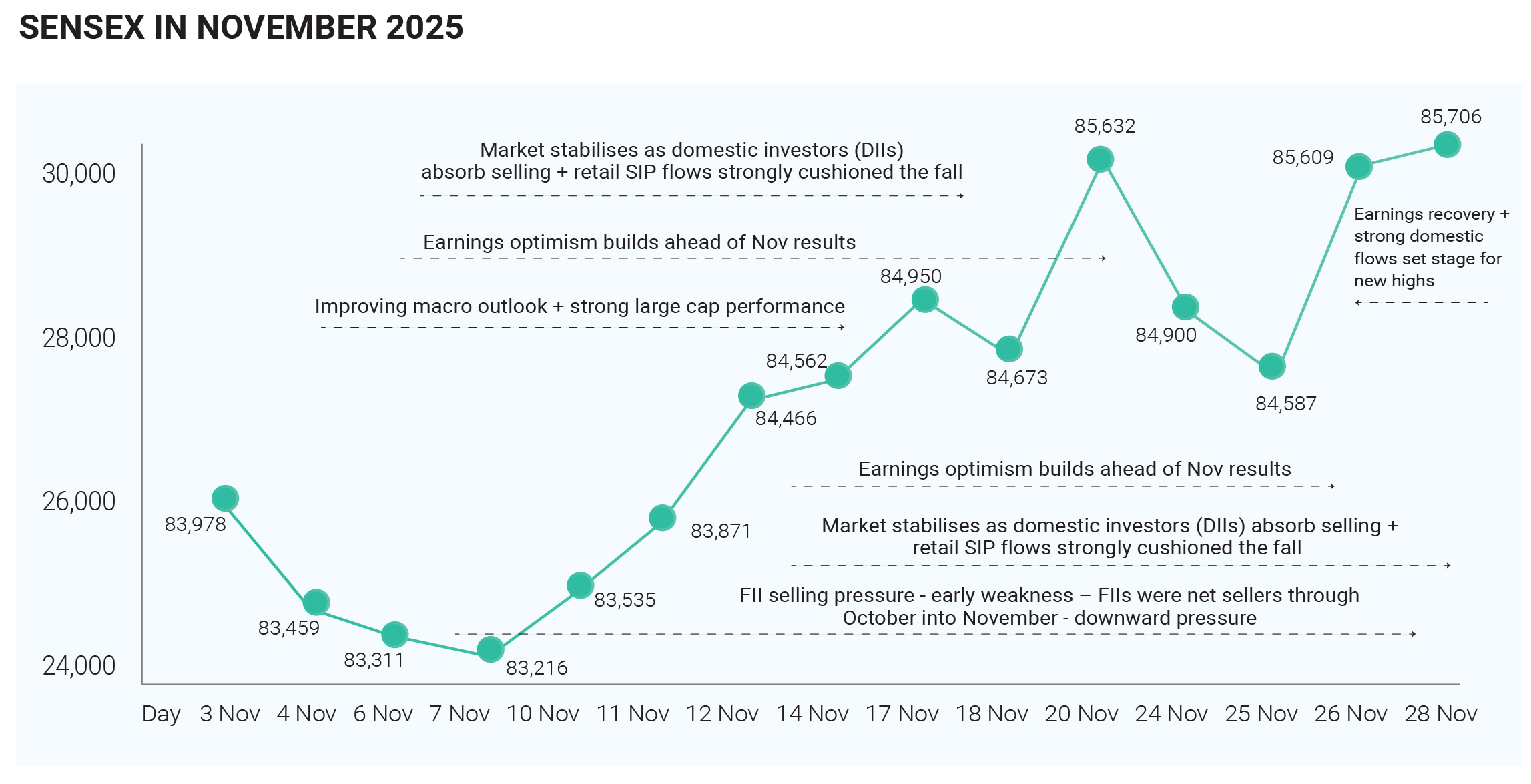
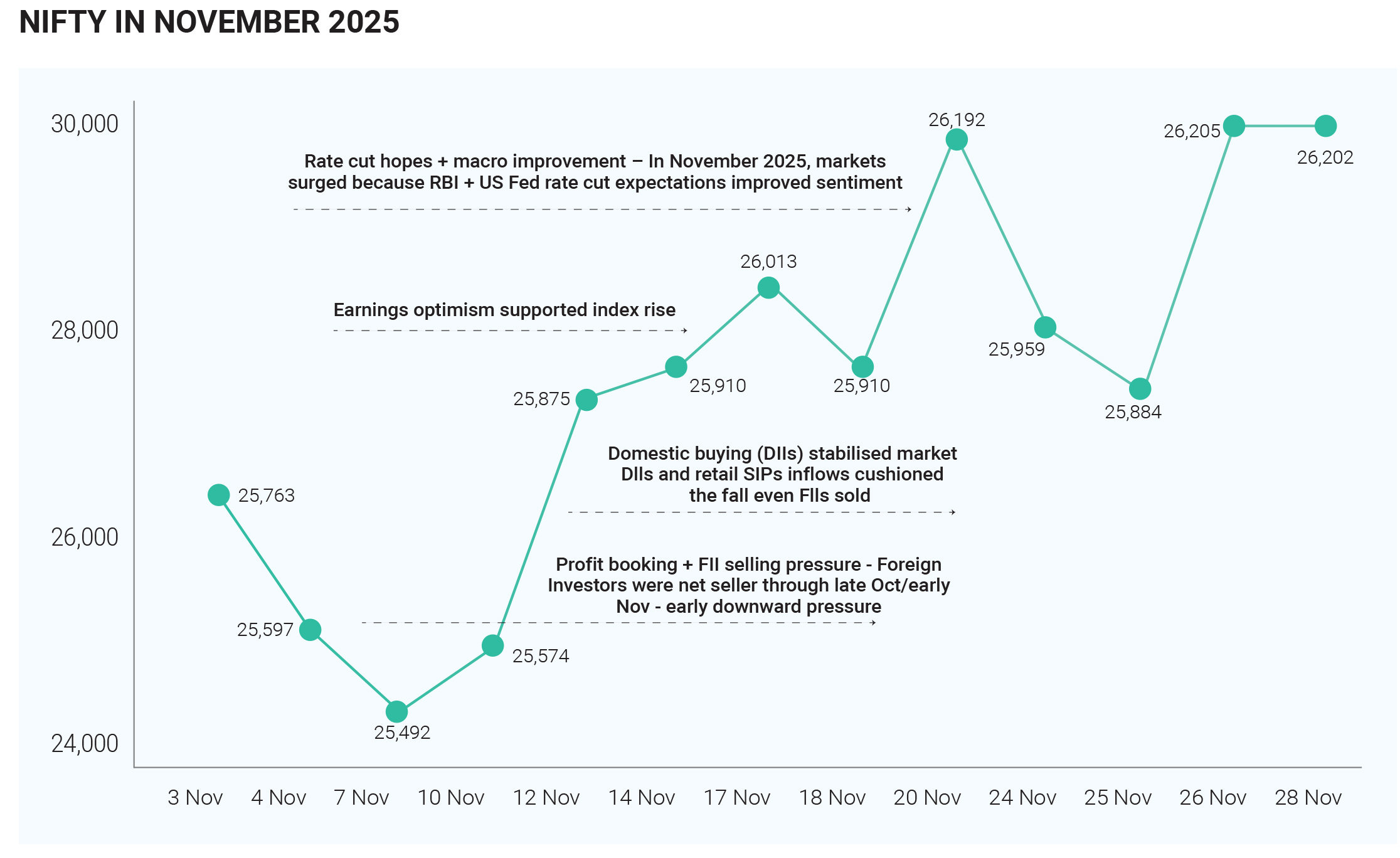
In November 2025, the Indian equity markets continued their upward trajectory, marking the third consecutive month of gains. The Nifty 50 rose by approximately 1.87% during the month, while the BSE Sensex also posted modest gains, oscillating around the 85,000–86,000 range. Despite intermittent volatility and foreign investor selling pressure, domestic institutional support, strong economic data, and sectoral outperformance—especially in technology and healthcare—helped sustain overall market strength. The Sensex touched intraday highs above 86,000 in mid-November before settling slightly lower by month-end. Market breadth remained positive but weaker than in October, with 30 advancing stocks versus 20 declining stocks on the Nifty, resulting in an advance-decline ratio of 1.5. In the final week of November (ending on the 28th), the Sensex gained around 0.56%, reflecting resilience despite turbulence in global and domestic cues.
Technology emerged as the strongest-performing sector
with a weighted return of 4.53%, driven by gains in firms
such as Tech Mahindra, HCL Technologies, and Infosys.
Healthcare also delivered impressive performance at
4.16%, benefiting from defensive positioning and stable
demand. The energy sector gained around 3.49%, lending
additional support to broader indices. In contrast, utilities
proved to be the biggest underperformer, falling by
3.85%. This decline was driven by weakness in
heavyweight stocks such as Power Grid and NTPC,
which were affected by softer power demand and
operational pressures. Consumer defensive stocks also
slipped by 1.95%, reflecting subdued sentiment around
staple goods and cautious consumer spending patterns.
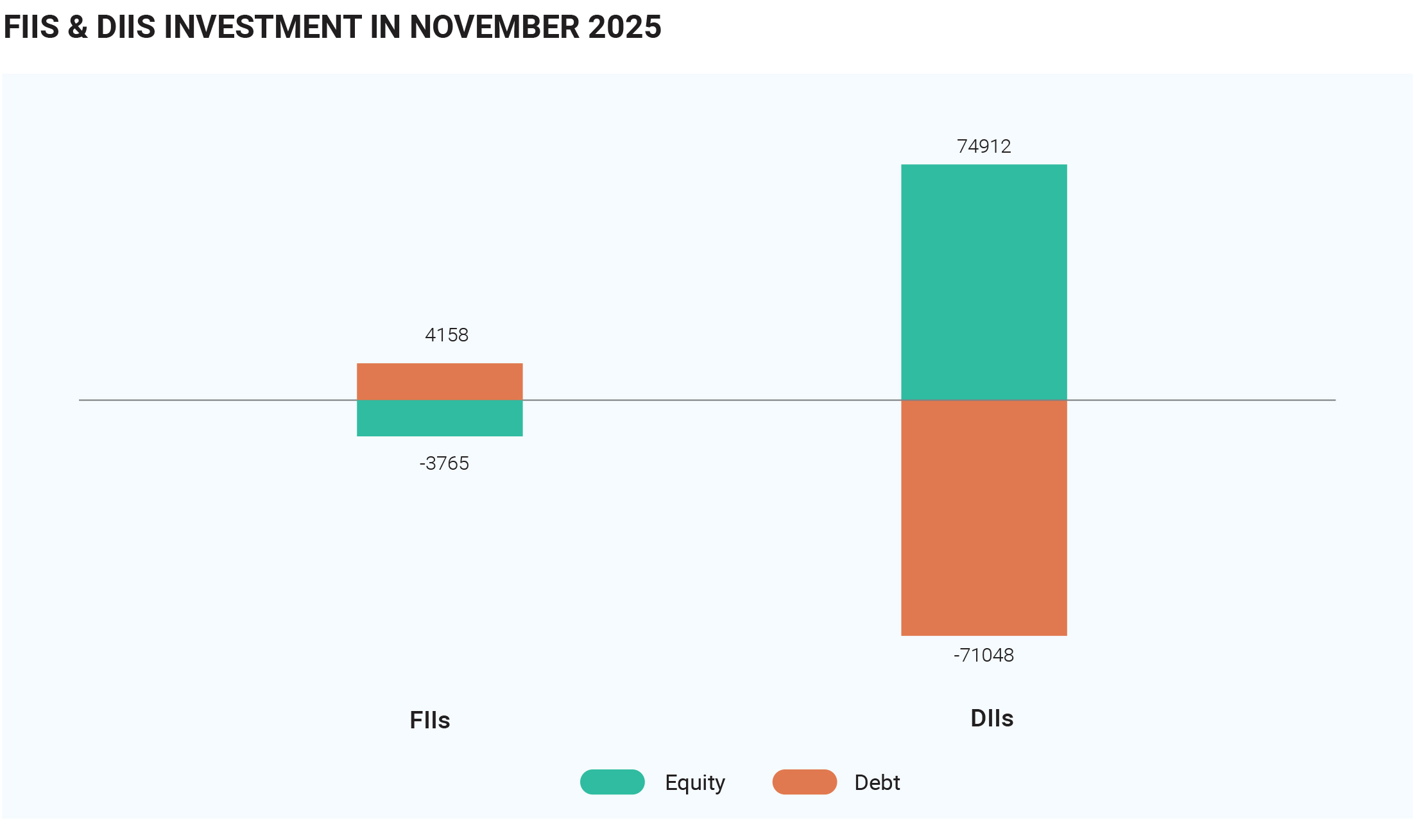
Foreign Institutional Investors (FIIs) emerged as net
sellers in November, pulling out approximately ₹12,500
crore from Indian equity markets in the secondary
segment. This outflow was primarily due to global
portfolio rebalancing towards AI-driven rallies in markets
such as the United States, China, and South Korea. There
were significant days of FII selling, including net outflows
of ₹4,171 crore on November 24 and ₹1,255 crore on
November 27. Although there were some instances of
buying (e.g., ₹4,581 crore on November 7), the overall
monthly trend was negative. However, Domestic
Institutional Investors (DIIs) effectively counterbalanced
the impact of this selling. Indian mutual funds, insurance
companies, and pension funds injected approximately
₹16,600 crore into equities, fuelled by consistent SIP
inflows and rising retail participation. Over the broader
period, DIIs invested nearly ₹77,083 crore (around $8.7
billion), marking approximately 28 consecutive months
of net buying. This sustained influx not only stabilized the
market but also elevated DII holdings above FII holdings
for the first time in recent history. Domestic buying was
concentrated in sectors such as financial services,
FMCG, technology, and healthcare.
Interestingly, while FIIs were net sellers in the secondary
market, they remained active in the primary market. Their
investments in IPOs totalled around ₹10,700 crore,
making November the second-highest monthly FII inflow
in primary markets for 2025. This highlights continued
long-term confidence in India’s structural growth story
despite short-term volatility in stock prices.
Internationally, equity markets experienced turbulence
early in the month. Global technology stocks underwent
a sharp correction, with the Nasdaq Composite falling
nearly 3% in the first week of November. Asian markets,
including Japan’s Nikkei and South Korea’s KOSPI,
dropped around 5% each, while European markets
weakened as well. This selloff was primarily driven by
high valuations and concerns over stretched profit
expectations
related
to artificial
intelligence
investments. As a result, developed market equities fell
about 1.3% during this phase. The longest U.S.
government shutdown in history — lasting 43 days —
ended in mid-November. However, it left behind
uncertainty regarding economic data flow, growth
projections, and potential Federal Reserve decisions.
These concerns led to flat global equity returns for the
month, with developed markets posting gains of just
0.3%. Investors rotated into defensive sectors such as
healthcare and consumer staples. Adding to the
pressure, China’s October trade data revealed a decline in
exports, heightening concerns over weak global demand
and insufficient stimulus measures. This weighed on
commodity prices and emerging markets that are closely
tied to Chinese demand. Geopolitical tensions also
persisted, along with falling energy prices and a
strengthening U.S. dollar. These factors increased
safe-haven demand, easing U.S. Treasury yields but
weakening emerging market currencies. Fiscal
uncertainties—especially UK budget issues and
concerns over U.S. tariffs—further unsettled global bond
and equity markets toward the end of the month.
Despite global headwinds, India showed strong
macroeconomic resilience. Q2 GDP growth surprised on
the upside, coming in at 8.2%, significantly above
expectations. This boosted investor confidence,
especially in sectors such as financials and information
technology. Strong corporate earnings, including major
deals such as TCS’s SAP contract, reinforced positive
sentiment. Mid-cap and small-cap companies posted
profit-after-tax growth of 27–37% year-on-year, adding to
the optimism in the broader market. Another key support
factor was the indication by the Reserve Bank of India of
a possible interest rate cut. With October CPI inflation at
just 0.3%, expectations grew of a policy rate reduction to
around 5.25% in December. This outlook benefited
interest-rate sensitive sectors like banking and
automobiles and supported the broader indices’ gains.
In conclusion, November 2025 reflected a delicate
balance between global uncertainty and domestic
strength. Although FIIs withdrew capital from Indian
equities and international markets remained volatile due
to technology corrections, geopolitical issues, and weak
trade data from China, the Indian market held firm.
Strong GDP growth, RBI’s accommodative signals, robust
corporate earnings, and record domestic inflows
ensured that both Nifty and Sensex closed the month in
positive territory. By early December, the Sensex had
even extended its gains, reaching 85,712 and reflecting a
2.88% upward movement into the new period. This
underlined India’s relative resilience in a challenging
global environment.