Topic 1: EQUITY: RADIANT GAINS
In October 2025, Indian equity markets demonstrated
remarkable resilience and strength, with both the Sensex
and Nifty registering strong monthly gains despite
closing the month on a slightly weaker note. The
market’s trajectory was defined by alternating phases of
optimism and caution—early enthusiasm fuelled by
robust corporate earnings and sustained foreign inflows
drove benchmarks to record highs, but profit-booking
and global headwinds toward the month’s end triggered a
mild pullback. This dual-phase performance captured the
complex balance between domestic growth optimism
and external vulnerabilities as investors navigated an
environment shaped by earnings momentum, regulatory
changes,
and
volatile
international
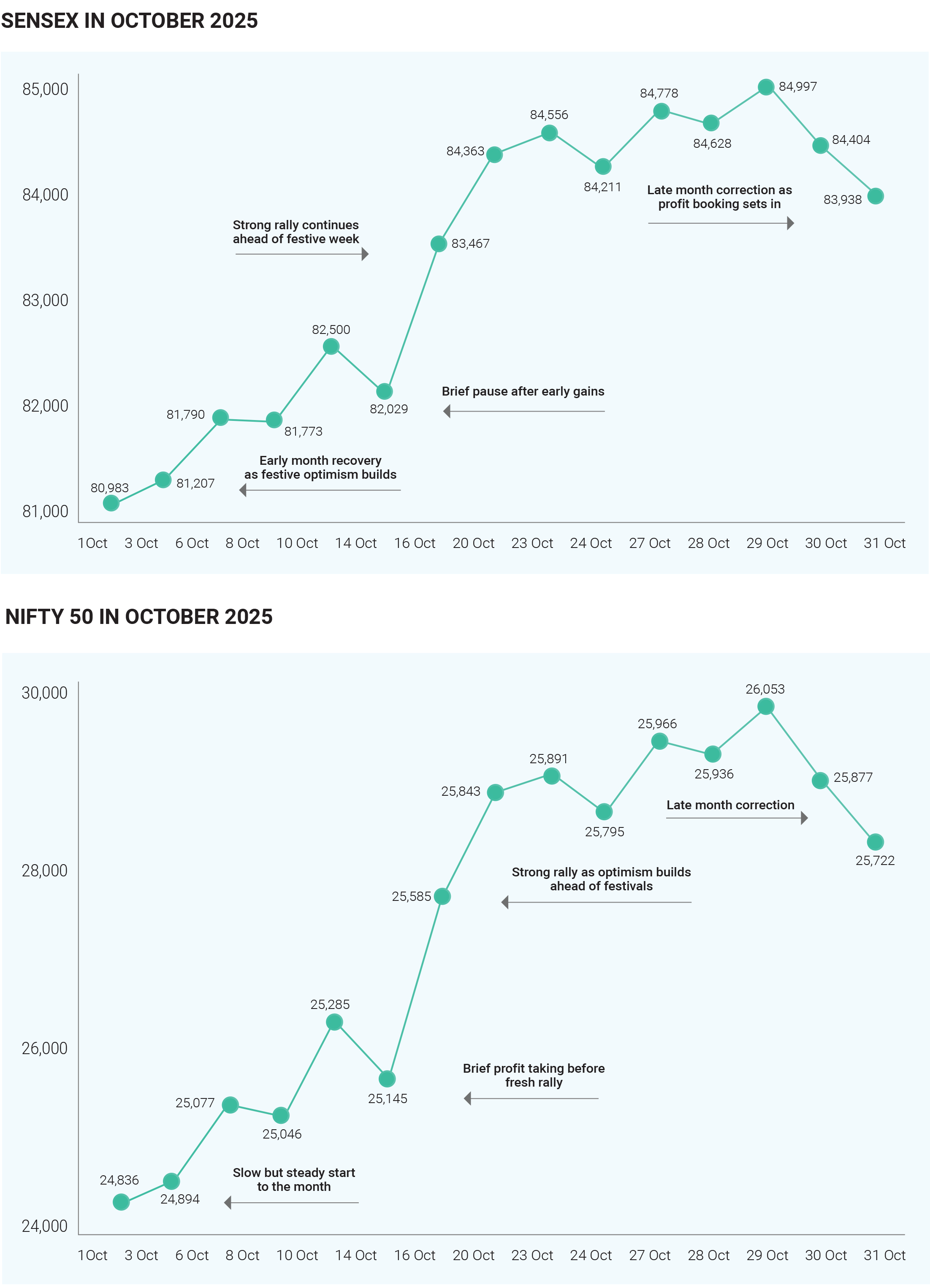
By October 31, 2025, the Sensex settled at 83,938.71,
down 0.55% for the day, while the Nifty closed at
25,722.10, slipping 0.60%. Despite these end-of-month
declines, both indices recorded impressive monthly
advances of nearly 5%—their best performance since
March 2025. The rally was largely fuelled by strong Q2
FY26 earnings and steady foreign portfolio inflows,
particularly into technology, public sector banking, and
telecom stocks such as Bharti Airtel, which touched
record highs during the period. Midcap and small-cap
segments also participated enthusiastically, signalling
broad-based investor confidence. However, the market’s
upward momentum moderated in the final week as
investors opted to lock in profits after sustained gains.
Banking and financial stocks came under notable
pressure following regulatory changes announced by
SEBI that affected Bank Nifty derivatives. Major private
lenders like HDFC Bank and ICICI Bank witnessed heavy
profit-taking, contributing to the overall market’s
weakness. Meanwhile, defensive segments such as
healthcare, pharmaceuticals, and metals also faced mild
declines, as investors rotated capital toward cyclical and
growth-oriented sectors during the earlier bullish stretch.
The Sensex and Nifty’s performance throughout the
month followed a clear pattern—strong early gains driven
by robust buying in IT and banking counters, followed by
a corrective phase triggered by global caution and
sectoral profit-booking. Despite the late weakness, PSU
banks and oil & gas companies provided crucial support,
helping markets sustain their monthly gains.
Global developments exerted significant influence on
market sentiment. Mixed signals from the U.S. Federal
Reserve, especially regarding the timing of potential rate
cuts, weighed on investor confidence. The Fed’s cautious
stance and a stronger U.S. dollar led to intermittent
foreign outflows, slightly dampening risk appetite.
Inflationary pressures in the U.S. and Europe prompted
further tightening by the Federal Reserve and European
Central Bank, temporarily unsettling global equity flows.
Weak global demand also persisted, particularly
affecting India’s export
oriented sectors such as IT, pharmaceuticals, and
textiles.
These
challenges
underscored
the
interconnected nature of Indian equities with global
macroeconomic dynamics, even as domestic
fundamentals remained robust.
On the domestic front, the Q2 earnings season played a
pivotal role in shaping market behaviour. Stellar results
from large-cap companies such as Tata Consultancy
Services (TCS) and strong operational updates from
several blue-chip firms boosted sentiment in the early
part of the month. The primary market also witnessed
heightened activity, with major IPOs like Tata Capital and
Groww attracting overwhelming investor participation.
These new listings diverted liquidity temporarily but
underscored the deepening retail and institutional
engagement in Indian equities. The influx of new capital
through IPOs and mutual fund inflows highlighted
investors’ growing confidence in India’s structural growth
story.
However, by the final week of October, the market’s
four-week winning streak came to an end as heavy
profit-booking set in. Small-cap stocks, however,
continued to outperform, reflecting investor appetite for
higher-risk, high-reward opportunities. Public sector
undertakings (PSUs), particularly in banking and energy,
emerged as notable outperformers, offering relative
stability amid the broader correction. Conversely, IT and
private banking counters, which had driven much of the
earlier rally, bore the brunt of the sell-off as valuations
turned rich and traders sought to lock in gains.
The interplay of these forces created a turbulent yet
opportunity-rich environment throughout the month.
Sector rotation was a key theme, with investors
dynamically shifting exposure between cyclical,
defensive, and value-oriented plays in response to
earnings updates, policy changes, and global signals.
Among the primary reasons for the late-month correction
were profit-booking after a sustained rally and uneven
performance across key corporate earnings. Regulatory
announcements, including SEBI’s circular affecting large
private banks’ eligibility norms for derivatives, added to
banking sector uncertainty. Meanwhile, global central
banks’ cautious tone and the continued strength of the
U.S. dollar further deterred aggressive risk-taking by
foreign investors.
Despite these headwinds, the broader narrative remained
optimistic. The resilience of PSU banks and strength in
oil & gas counters reflected selective investor confidence
in value sectors. The buoyant IPO market and steady
mutual fund inflows pointed to deepening domestic
participation. Both foreign and domestic investors
played vital roles in sustaining the market’s strength.
After several months of outflows, Foreign Institutional
Investors (FIIs) returned as net buyers, while Domestic
Institutional Investors (DIIs) maintained consistent
support through steady inflows. This combined
participation helped markets absorb volatility effectively.
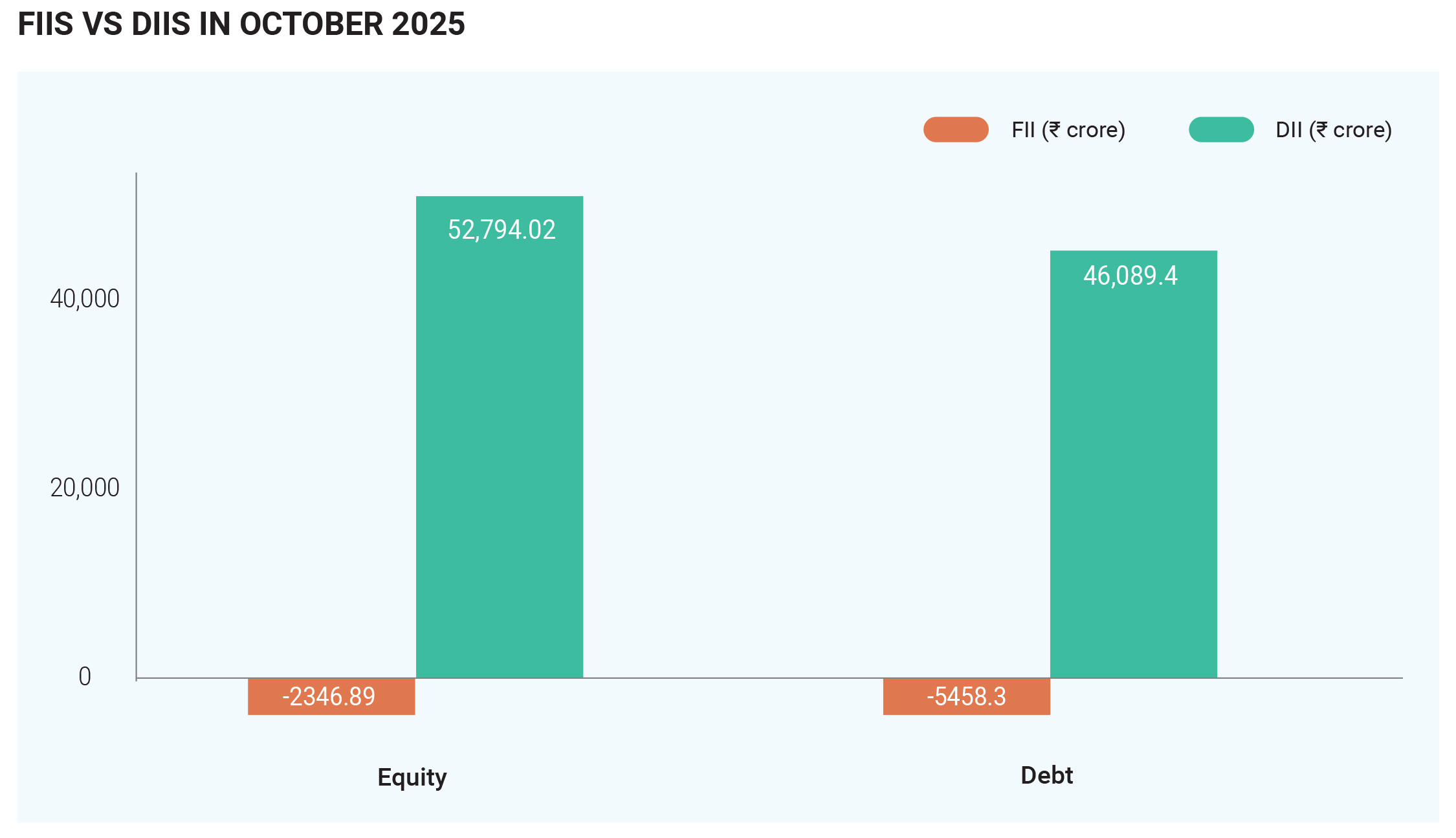
FIIs, who had been net sellers from July to September,
reversed course in mid-October, recording their first
positive monthly inflow since June 2025. They
collectively purchased around ₹10,040 crore during the
month, signalling renewed confidence in India’s
macroeconomic prospects. The standout moment came
on October 28, when FIIs logged their largest single-day
purchase—over ₹10,300 crore—marking a decisive shift
from the selling trend of previous months. DIIs remained
steadfast, adding approximately ₹9,537 crore in net
inflows by month-end. Their steady buying offset early
volatility from FIIs and provided a stabilizing cushion
during periods of profit-taking. FIIs particularly increased
exposure to state-run banks, aligning with the PSU
banking rally, while DIIs favoured financials and
consumer-oriented sectors. The revival in FII sentiment
was primarily driven by expectations of a potential U.S.
Federal Reserve rate cut, moderation in the U.S. dollar,
and resilient domestic earnings. Meanwhile, DIIs
continued to deploy funds through systematic
investment plans (SIPs) and tactical sectoral allocations.
Together, these trends underscored renewed global and
domestic confidence in Indian equities.
In conclusion, October 2025 epitomized the dual nature
of India’s stock markets—buoyed by strong domestic
fundamentals
and
corporate
performance
yet
periodically tested by global uncertainties and regulatory
developments. Despite short-term volatility, both the
Sensex and Nifty posted commendable monthly gains of
about 5%, reaffirming India’s standing as one of the most
resilient and attractive investment destinations amid
global turbulence. While short-term consolidation may
persist, the medium-term outlook for equities remains
positive, underpinned by steady economic growth, robust
earnings momentum, and expanding retail investor
participation.