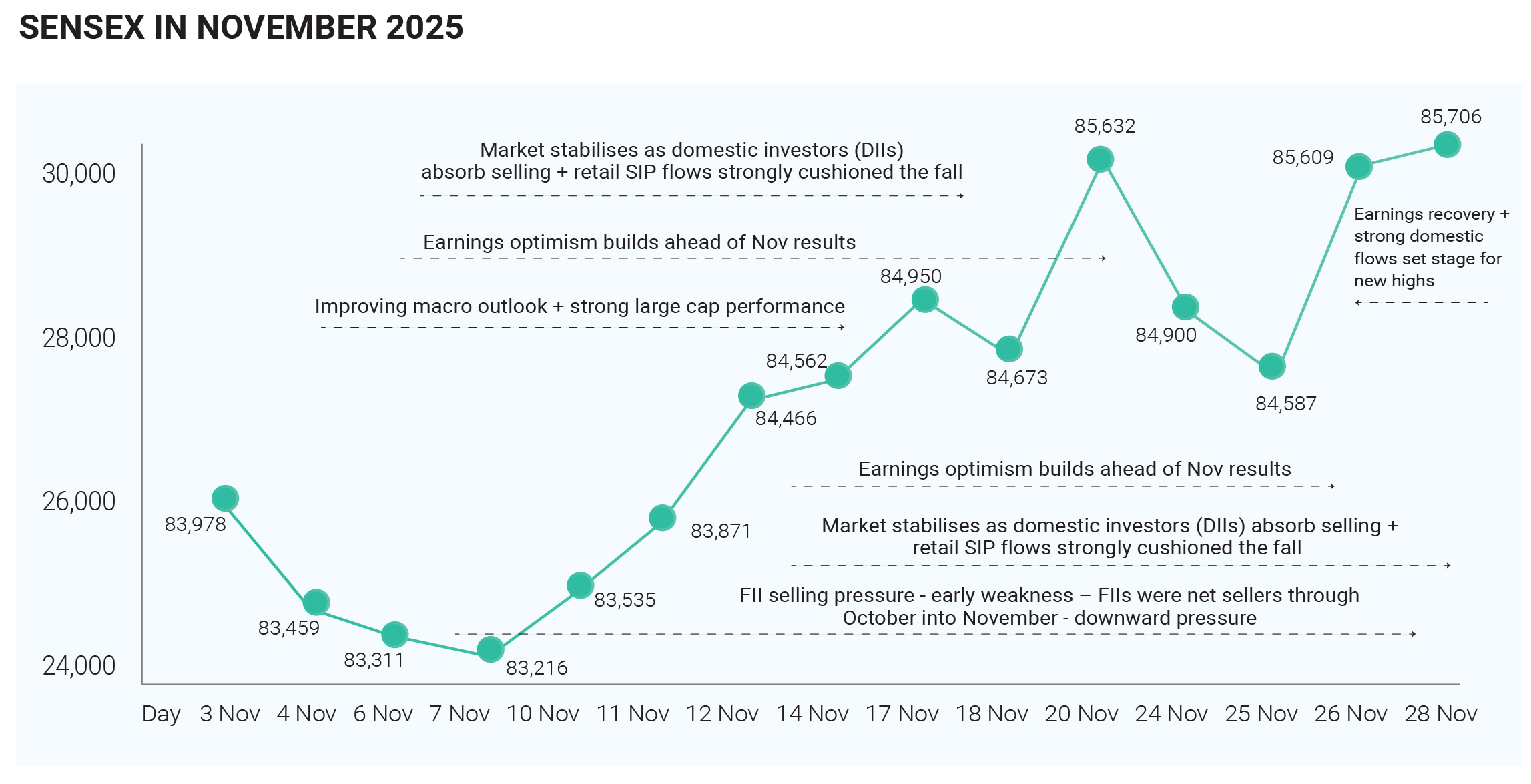
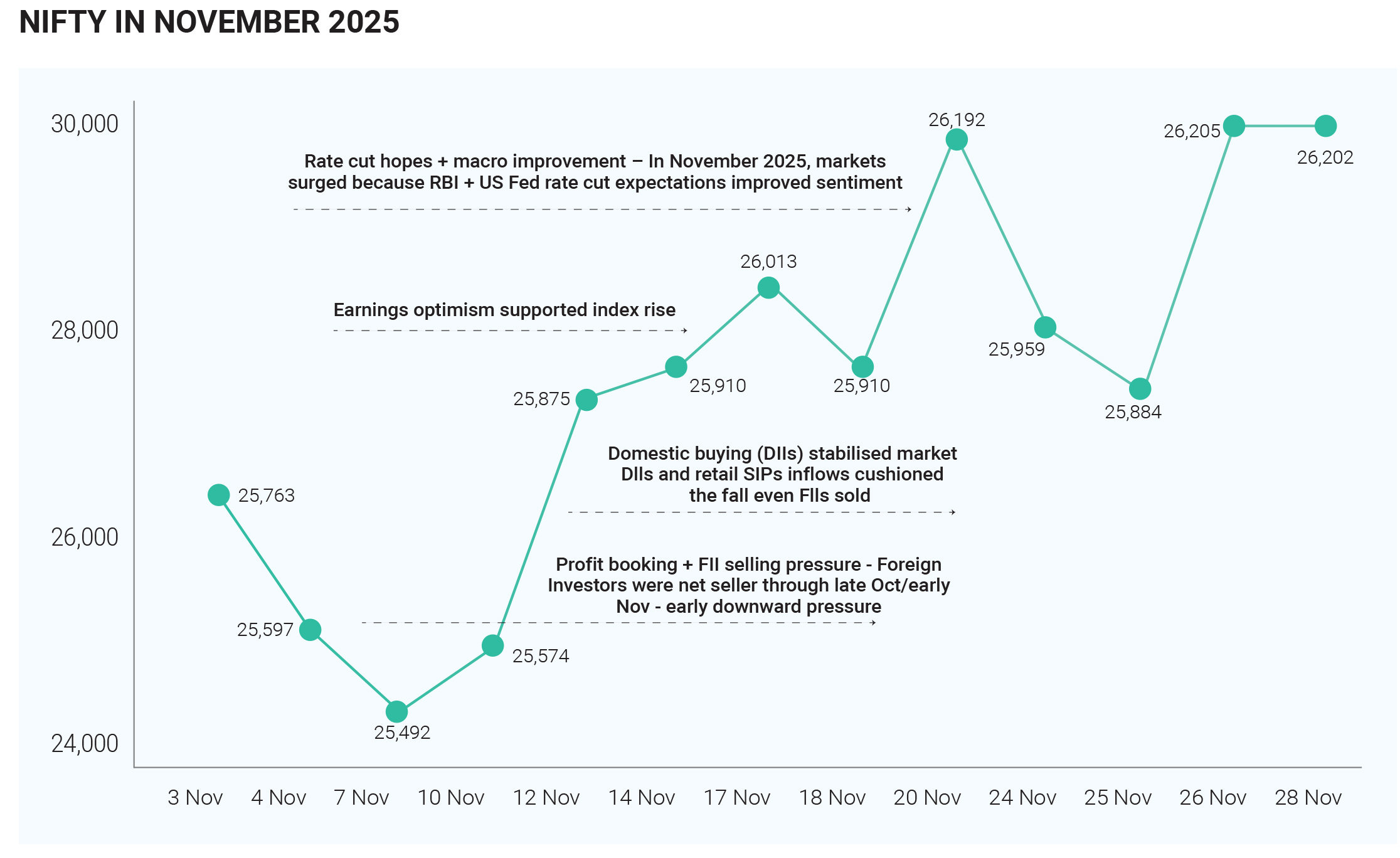
In November 2025, the Indian equity markets continued their upward trajectory, marking the third consecutive month of gains. The Nifty 50 rose by approximately 1.87% during the month, while the BSE Sensex also posted modest gains, oscillating around the 85,000–86,000 range. Despite intermittent volatility and foreign investor selling pressure, domestic institutional support, strong economic data, and sectoral outperformance—especially in technology and healthcare—helped sustain overall market strength. The Sensex touched intraday highs above 86,000 in mid-November before settling slightly lower by month-end. Market breadth remained positive but weaker than in October, with 30 advancing stocks versus 20 declining stocks on the Nifty, resulting in an advance-decline ratio of 1.5. In the final week of November (ending on the 28th), the Sensex gained around 0.56%, reflecting resilience despite turbulence in global and domestic cues.
Technology emerged as the strongest-performing sector
with a weighted return of 4.53%, driven by gains in firms
such as Tech Mahindra, HCL Technologies, and Infosys.
Healthcare also delivered impressive performance at
4.16%, benefiting from defensive positioning and stable
demand. The energy sector gained around 3.49%, lending
additional support to broader indices. In contrast, utilities
proved to be the biggest underperformer, falling by
3.85%. This decline was driven by weakness in
heavyweight stocks such as Power Grid and NTPC,
which were affected by softer power demand and
operational pressures. Consumer defensive stocks also
slipped by 1.95%, reflecting subdued sentiment around
staple goods and cautious consumer spending patterns.
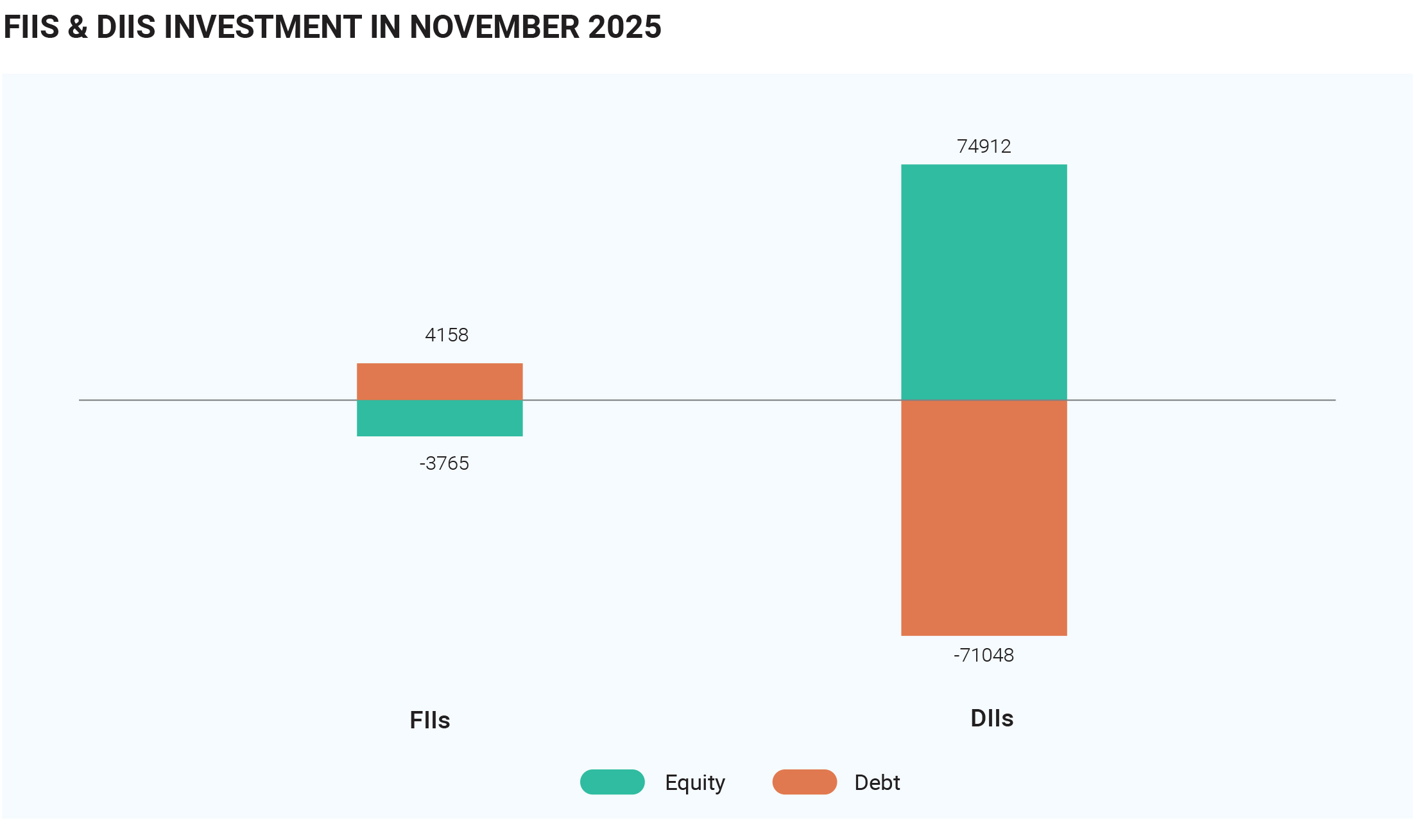
Foreign Institutional Investors (FIIs) emerged as net
sellers in November, pulling out approximately ₹12,500
crore from Indian equity markets in the secondary
segment. This outflow was primarily due to global
portfolio rebalancing towards AI-driven rallies in markets
such as the United States, China, and South Korea. There
were significant days of FII selling, including net outflows
of ₹4,171 crore on November 24 and ₹1,255 crore on
November 27. Although there were some instances of
buying (e.g., ₹4,581 crore on November 7), the overall
monthly trend was negative. However, Domestic
Institutional Investors (DIIs) effectively counterbalanced
the impact of this selling. Indian mutual funds, insurance
companies, and pension funds injected approximately
₹16,600 crore into equities, fuelled by consistent SIP
inflows and rising retail participation. Over the broader
period, DIIs invested nearly ₹77,083 crore (around $8.7
billion), marking approximately 28 consecutive months
of net buying. This sustained influx not only stabilized the
market but also elevated DII holdings above FII holdings
for the first time in recent history. Domestic buying was
concentrated in sectors such as financial services,
FMCG, technology, and healthcare.
Interestingly, while FIIs were net sellers in the secondary
market, they remained active in the primary market. Their
investments in IPOs totalled around ₹10,700 crore,
making November the second-highest monthly FII inflow
in primary markets for 2025. This highlights continued
long-term confidence in India’s structural growth story
despite short-term volatility in stock prices.
Internationally, equity markets experienced turbulence
early in the month. Global technology stocks underwent
a sharp correction, with the Nasdaq Composite falling
nearly 3% in the first week of November. Asian markets,
including Japan’s Nikkei and South Korea’s KOSPI,
dropped around 5% each, while European markets
weakened as well. This selloff was primarily driven by
high valuations and concerns over stretched profit
expectations
related
to artificial
intelligence
investments. As a result, developed market equities fell
about 1.3% during this phase. The longest U.S.
government shutdown in history — lasting 43 days —
ended in mid-November. However, it left behind
uncertainty regarding economic data flow, growth
projections, and potential Federal Reserve decisions.
These concerns led to flat global equity returns for the
month, with developed markets posting gains of just
0.3%. Investors rotated into defensive sectors such as
healthcare and consumer staples. Adding to the
pressure, China’s October trade data revealed a decline in
exports, heightening concerns over weak global demand
and insufficient stimulus measures. This weighed on
commodity prices and emerging markets that are closely
tied to Chinese demand. Geopolitical tensions also
persisted, along with falling energy prices and a
strengthening U.S. dollar. These factors increased
safe-haven demand, easing U.S. Treasury yields but
weakening emerging market currencies. Fiscal
uncertainties—especially UK budget issues and
concerns over U.S. tariffs—further unsettled global bond
and equity markets toward the end of the month.
Despite global headwinds, India showed strong
macroeconomic resilience. Q2 GDP growth surprised on
the upside, coming in at 8.2%, significantly above
expectations. This boosted investor confidence,
especially in sectors such as financials and information
technology. Strong corporate earnings, including major
deals such as TCS’s SAP contract, reinforced positive
sentiment. Mid-cap and small-cap companies posted
profit-after-tax growth of 27–37% year-on-year, adding to
the optimism in the broader market. Another key support
factor was the indication by the Reserve Bank of India of
a possible interest rate cut. With October CPI inflation at
just 0.3%, expectations grew of a policy rate reduction to
around 5.25% in December. This outlook benefited
interest-rate sensitive sectors like banking and
automobiles and supported the broader indices’ gains.
In conclusion, November 2025 reflected a delicate
balance between global uncertainty and domestic
strength. Although FIIs withdrew capital from Indian
equities and international markets remained volatile due
to technology corrections, geopolitical issues, and weak
trade data from China, the Indian market held firm.
Strong GDP growth, RBI’s accommodative signals, robust
corporate earnings, and record domestic inflows
ensured that both Nifty and Sensex closed the month in
positive territory. By early December, the Sensex had
even extended its gains, reaching 85,712 and reflecting a
2.88% upward movement into the new period. This
underlined India’s relative resilience in a challenging
global environment.
In November 2025, India’s debt market remained broadly
stable, supported by the Reserve Bank of India’s
accommodative stance, comfortable domestic liquidity,
and easing inflationary pressures. Although foreign
portfolio investor (FPI) activity created intermittent
volatility, strong local demand and supportive central
bank measures helped moderate sharp yield movements,
allowing bond prices to post modest gains by the end of
the month.
The benchmark 10-year government security (6.33%
2035) yield softened slightly over the period. It declined
from around 6.57% at the beginning of November to
close near 6.50–6.54% by November 28. This gradual fall
in yields reflected mild price appreciation in government
bonds. Liquidity conditions improved during the month,
with surplus liquidity rising to approximately ₹1.2 trillion,
which further supported bond prices and reduced
funding costs for banks and financial institutions.
The yield curve steepened in November as short-term
yields declined more rapidly than long-term yields. This
steepening was driven by the RBI’s surprise repo rate cut
to 6% and a reaffirmation of its accommodative policy
stance. Short-end bond yields were quick to respond to
expectations of easier monetary conditions, while
longer-dated bonds remained stable due to persistent
global uncertainty and elevated international yields. The
5-year government bond yield traded in the range of
approximately 6.11% to 6.20% during the latter part of the
month, while mid-month indicative yields stood around
6.01% for 4–5 year maturities and 6.53% for 9–10-year
maturities.
Money market rates also reflected improving liquidity,
though they ticked up slightly toward the end of the
month. The interbank rate hovered near 5.50%, remaining
mostly rangebound. Expectations of aggressive future
rate cuts faded somewhat as strong GDP growth
forecasts tempered the likelihood of rapid policy easing.
India’s Q2 GDP was projected in the range of 6.5%–6.8%,
highlighting the economy’s resilience and limiting sharp
declines in longer-term bond yields.
On the corporate bond front, yields showed some
firmness despite the RBI’s rate cut. Supply pressures
from increased corporate issuance and cautious
sentiment kept borrowing costs elevated in this segment.
As a result, corporate bond yields did not soften as much
as
government securities, although overall market
conditions remained orderly.
Foreign portfolio investor activity was mixed throughout the
month. Elevated U.S. bond yields—hovering near
4.2%—along with global financial volatility renewed some
pressure on emerging market debt, including India’s. The
Indian rupee also weakened to record lows of around ₹89.55
per U.S. dollar, triggering a partial pullback by some
overseas investors. These factors contributed to modest FPI
outflows at various points during November. However, FPIs
still recorded net inflows of approximately ₹5,760 crore into
Indian debt through Fully Accessible Route (FAR) eligible
bonds. Simultaneously, under the general debt limits, FPIs
invested about ₹8,114 crore. These inflows were partially
offset by outflows of around ₹5,053 crore from the Voluntary
Retention Route (VRR), leading to overall muted, though net
positive, participation. Compared to earlier expectations of
$20–25 billion in annual inflows following FAR expansion,
total year-to-date debt inflows stood lower at around
₹69,073 crore (around $7.8 billion).
Several factors continued to attract foreign interest in Indian
bonds. Yield differentials between India and other major
emerging markets—especially China—remained attractive.
In addition, expectations of further RBI support through open
market operations (OMOs) and the possibility of India’s
inclusion in the Bloomberg Global Aggregate Bond Index
encouraged selective inflows despite the weak currency and
global uncertainties.
Overall, India’s bond market in November 2025
demonstrated relative resilience. While equity markets
experienced volatility and foreign investors turned cautious
in riskier segments, the debt market benefited from stable
inflation (CPI at 3.16%), improving domestic liquidity, and
ongoing RBI support. These factors together contributed to
a mild decline in bond yields and supported overall market
stability, preventing sharp downside movements and
reinforcing confidence in India’s fixed income outlook.
The Indian rupee weakened moderately against the US
dollar in November 2025, declining by approximately
0.8–1.0% over the month. It opened near ₹88.77 on
November 1 and initially traded in a tight and relatively
stable range of ₹88.46 to ₹88.89 through the first half of
the month, with an average rate around ₹88.88. However,
selling pressure increased toward the end of November,
and the rupee slipped to lows of around ₹89.36–₹89.71
by month-end, setting new record levels before declining
even further in early December. One of the primary drivers
of depreciation was sustained Foreign Portfolio Investor
(FPI) equity outflows. During November, FPIs sold Indian
equities worth between ₹12,500 and ₹17,500 crore as
they reallocated capital toward stronger, AI-driven rallies
in US markets and adopted a more risk-averse stance
globally. Since August, total equity outflows had reached
nearly $16.5 billion, increasing dollar demand and putting
sustained pressure on the rupee.
The pressure on the currency was further aggravated by
adverse trade developments. The imposition of 50%
tariffs on certain Indian exports by the United States from
late August significantly affected export inflows. As the
US is India’s largest export market, the trade deficit
widened sharply to a record $41.7 billion in October,
leading to reduced dollar earnings for Indian exporters.
At the same time, importer demand for dollars rose
sharply, particularly for crude oil, gold, and electronics,
deepening the supply-demand mismatch in the foreign
exchange market.
Global factors played a crucial role in the rupee’s
underperformance. A stronger US dollar, US bond yields
hovering near 4.2%, fading expectations of Federal
Reserve rate cuts following strong US jobs data, and
ongoing geopolitical tensions boosted safe-haven
demand for the dollar. Rising Japanese bond yields and
volatility in other Asian currencies also exerted regional
pressure on the rupee, making it one of the
weakest-performing Asian currencies during the month.
As a result, annualised daily volatility increased to around
4.9% in the latter half of November, reflecting heightened
uncertainty. Despite these weaknesses, certain domestic
factors limited a steeper fall. The Reserve Bank of India
maintained an accommodative monetary policy stance
after consumer inflation eased sharply to just 0.3%. This
provided some support to domestic sentiment and
prevented panic-driven selling. In addition, India’s strong
Q2 GDP growth of 8.2% reinforced confidence in the
country’s longer-term fundamentals, helping to absorb
some external shocks. RBI intervention in the currency
market appeared limited once the rupee broke the 88.80
level, but the central bank’s signals and liquidity
management helped slow the pace of depreciation.
Modest FPI inflows into Indian debt, amounting to around
₹5,760 crore, also provided partial support. There was some
temporary relief from optimism around potential US–India
trade negotiations, which helped to briefly stabilise the
exchange rate below ₹89 earlier in the month. However,
these supportive factors were overshadowed by persistent
dollar strength, heavy importer demand, a widening current
account deficit (which reached 1.3% of GDP, the highest in
2025), and continued global uncertainty. By the end of
November, the rupee had firmly crossed the ₹89 mark,
setting the stage for the sharper declines witnessed in early
December.
In summary, November 2025 marked by modest but
meaningful rupee depreciation, driven by strong external
headwinds and capital outflows, partly offset by supportive
domestic fundamentals and cautious central bank
measures.
Crude oil prices declined further in November 2025,
falling by approximately 2.6% over the month as
persistent oversupply and weak global demand
outweighed short-term geopolitical tensions. West Texas
Intermediate (WTI) crude opened near $64.89 per barrel
on November 1 and ended the month around $63.20.
Prices oscillated between a high of $65.10 on November
11 and a low of $61.57 on November 25, reflecting
ongoing bearish sentiment. Repeated failures to break
above the key $65 resistance level reinforced a negative
technical outlook.
The dominant factor behind the decline was a significant
global supply glut. OPEC+ increased production quotas
by 137,000 barrels per day in November, part of a broader
production rise of more than 2.5 million barrels per day
since April. The group’s strategy prioritized maintaining
market share rather than defending price levels. At the
same time, strong output from non-OPEC
producers—especially the United States, Brazil, and
Guyana—added further to excess supply. Global
oversupply was estimated at around 2.7 million barrels
per day, creating unsold cargoes and a rise in floating
storage.
US crude production remained at record levels, with
output holding around 13.6 million barrels per day
through November and forecasts of about 13.5 million
barrels per day for 2025–26. Growing inventories added
to
downward pressure on prices, with estimates
suggesting stock builds of roughly 2.6 million barrels per
day in the fourth quarter. Even new US sanctions on
Russian oil companies and Ukrainian attacks on Russian
refineries caused only brief upward price spikes of
around 5%, as Russian exports continued via shadow
fleets and alternative buyers, preventing any lasting
supply disruption.
On the demand side, economic weakness in major
consuming regions further depressed oil prices. China’s
October trade data indicated slowing exports, reinforcing
concerns of subdued energy demand from the world’s
largest oil importer. Uncertainty around the effectiveness
of Chinese stimulus measures added to bearish
sentiment. In the United States, consumption softened
amid economic and policy uncertainty, while global oil
demand growth was estimated at just 1.1 million barrels
per day—insufficient to absorb the rapid increase in
production.
Geopolitical tensions, including the ongoing Ukraine
conflict and global trade frictions driven by US tariff
policies, contributed to market volatility but did not
significantly disrupt physical supply flows. As a result,
price rallies remained short-lived and were quickly
reversed by technical selling, especially near the 50-day
moving average.
Overall, November 2025 was characterized by excess
supply, weak demand indicators, and strong resistance to
any sustained price recovery. The persistent imbalance
between production and consumption kept crude oil
under pressure, leading to a modest but steady monthly
decline and setting a fragile tone for the market heading
into December.
Gold and silver extended their strong rally in November
2025, supported by heightened safe-haven demand,
global uncertainty, and a powerful surge in
exchange-traded fund (ETF) inflows. Geopolitical
tensions, including Ukraine conflict and instability in the
Middle East, along with volatility in equity markets and
concerns over the US fiscal outlook, encouraged
investors to increase allocations to precious metals as
defensive and diversification assets. The depreciation of
the Indian rupee beyond ₹89 per US dollar further
strengthened domestic investment interest.
Silver significantly outperformed gold during the month,
supported by speculative momentum as well as
expectations of stronger industrial demand from sectors
such as renewable energy, electronics, and electric
vehicles. Uncertainty around China’s economic recovery
and persistent global trade tensions reinforced silver’s
appeal as both an industrial and safe-haven asset.
Meanwhile, weak crude oil prices and fragile risk
sentiment globally continued to push capital toward
alternative stores of value.
Monetary policy expectations also played a crucial role in
driving flows. Growing optimism around potential US
Federal Reserve rate cuts reduced real yields, making
non-yielding assets more attractive. In India, relatively
accommodative signals from the RBI supported
domestic demand for precious metals, even as the
contrast with a more cautious US Fed strengthened the
dollar and added to rupee depreciation pressures.
The most decisive factor behind November’s momentum
was the historic surge in ETF investments. Indian gold
ETFs, which had already recorded a record ₹7,743 crore
of inflows in October, sustained strong buying through
November. Year-to-date inflows reached approximately
₹276 billion (around US$3.1 billion), the highest level ever
recorded. Assets under management in gold ETFs more
than doubled within six months to cross ₹1.02 lakh crore,
while the number of investor folios rose sharply,
reflecting growing participation from both retail and
institutional investors seeking long-term portfolio
protection. At a global level, gold ETF holdings climbed to
around 3,932 tonnes by the end of November, marking
the sixth consecutive month of net additions. More than
700 tonnes were added to global ETFs in 2025,
underlining the strengthening role of gold in strategic
asset allocation. Continued central-bank accumulation,
including additional purchases by China, further
reinforced investor confidence. Silver ETFs registered
even stronger expansion. Assets under management
surged nearly 245% year-on-year to approximately
₹42,537 crore, while investor folios jumped by over 466%
to 25.29 lakh. Although sharp gains prompted some
profit booking, sustained inflows indicated continued
confidence in silver’s long-term structural demand.
Overall, November 2025 highlighted a decisive shift
toward paper-based investment in precious metals, with
ETFs emerging as the dominant driver of market
performance and signalling a more institutional,
long-term phase of the precious metals cycle.
Equity inflows fell 19% MoM to ₹24,690 crore in October
but rebounded late November with Nifty's 1.87% gain;
AUM approached ₹80 trillion, folios hit 23.8 crore, and
gold/silver ETFs recorded YTD ₹276bn inflows. Top
schemes like Nippon India Large Cap (9.88% 1Y)
outperformed amid FII. Funds pivoted to ultra-short debt
amid RBI rate uncertainty and fiscal deficit at 52.6% of
target, cutting long-duration bets as yields stayed above
6.5%.
SEBI proposed eliminating the additional 5 bps charge on
schemes (transitory exit load offset, reduced from 2018),
rationalizing TER definitions excluding statutory levies,
and capping brokerage to enhance unitholder costs.
Reforms tightened fund overlaps (value/contra ≤50%
portfolio), mandated 75% equity in equity funds (up from
65%), permitted sectoral debt schemes (≤60% overlap),
and
expanded
REITs/InvITs/residuals.
hybrids/arbitrage
New
AMC
framework
emphasized digital disclosures, 30-day rebalancing for
passive deviations, up to 6 goal-based target date funds
(3/5/10Y lock-ins), and stricter replication rules.
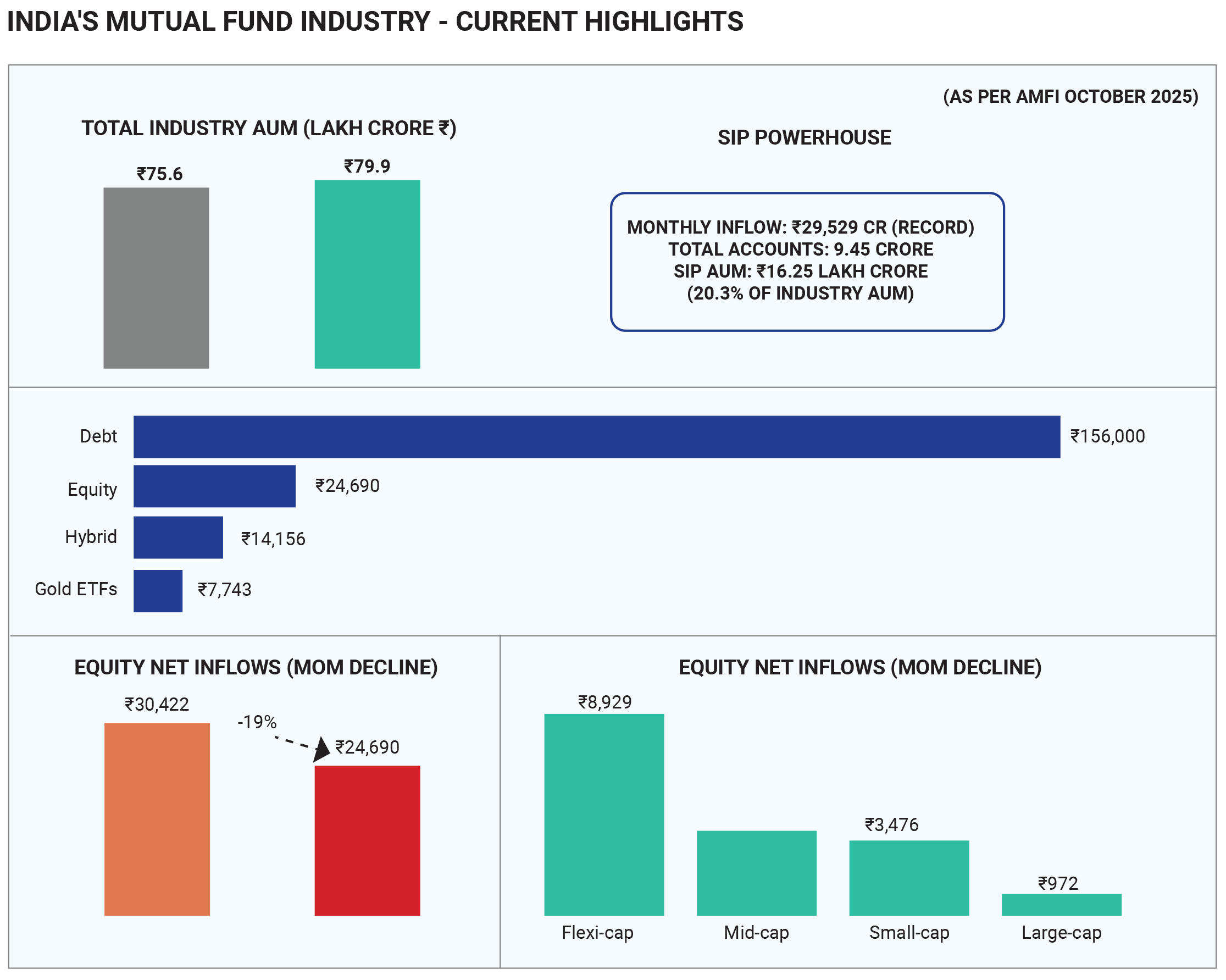
India’s mutual fund industry AUM reached a record ₹79.9
lakh crore (up from ₹75.6 lakh crore in September),
propelled by mark-to-market gains and robust retail
participation
despite
moderated equity inflows.
Equity-oriented schemes attracted ₹24,690 crore net
inflows—the 56th consecutive positive month—but
declined 19% MoM from ₹30,422 crore, signalling caution
amid volatility; flexi-cap led at ₹8,929 crore, while
large-cap fell to ₹972 crore, mid-cap dropped 25% to
₹3,807 crore, and small-cap eased 20% to ₹3,476 crore.
Debt funds surged with ₹1.56 lakh crore inflows, hybrids
added ₹14,156 crore (arbitrage ₹6,920 crore dominant),
and gold ETFs shone at ₹7,743 crore, reflecting
safe-haven shifts. SIPs hit a second straight record at
₹29,529 crore (+0.57% MoM) from 9.45 crore accounts,
with AUM at ₹16.25 lakh crore (20.3% of industry total).
New fund offers (18 open-ended schemes) mobilized
₹6,062 crore, including ₹4,173 crore from equity; folios
rose to 25.6 crore. Four Specialized Investment Funds
(SIFs) debuted, garnering ₹2,005 crore AUM by
month-end. Overall, growth underscored SIP resilience
and diversification amid FII outflows.
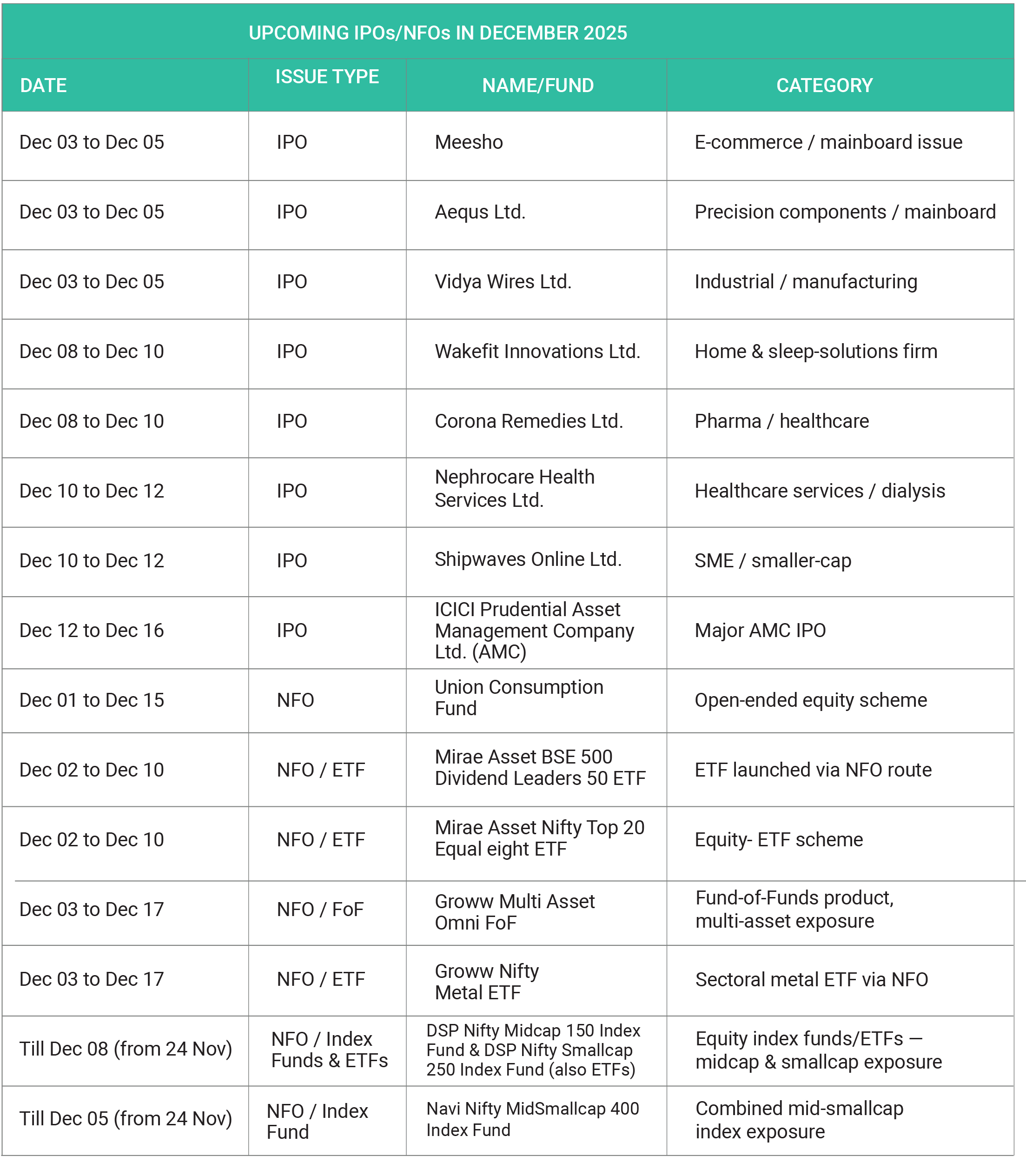
After December 5th , RBI’s 25 bps repo rate cut to 5.25%
(125 bps in 2025) signals continued monetary easing
amid low inflation, strengthening investor confidence.
target, cutting long-duration bets as yields stayed above
6.5%.
SEBI proposed eliminating the additional 5 bps charge
on schemes (transitory exit load offset, reduced from
2018), rationalizing TER definitions excluding statutory
levies, and capping brokerage to enhance unitholder
costs. Reforms tightened fund overlaps (value/contra ≤
50% portfolio), mandated 75% equity in equity funds (up
from 65%), permitted sectoral debt schemes (≤60%
overlap), and expanded hybrids/arbitrage to
REITs/InvITs/residuals.
New
AMC
framework
emphasized digital disclosures, 30-day rebalancing for
passive deviations, up to 6 goal-based target date funds
(3/5/10Y lock-ins), and stricter replication rules.
India’s mutual fund industry AUM reached a record ₹79.9
lakh crore (up from ₹75.6 lakh crore in September),
to
propelled by mark-to-market gains and robust retail
participation
despite
moderated equity inflows.
Equity-oriented schemes attracted ₹24,690 crore net
inflows—the 56th consecutive positive month—but
declined 19% MoM from ₹30,422 crore, signalling
caution amid volatility; flexi-cap led at ₹8,929 crore, while
large-cap fell to ₹972 crore, mid-cap dropped 25% to
₹3,807 crore, and small-cap eased 20% to ₹3,476 crore.
Debt funds surged with ₹1.56 lakh crore inflows, hybrids
added ₹14,156 crore (arbitrage ₹6,920 crore dominant),
and gold ETFs shone at ₹7,743 crore, reflecting
safe-haven shifts. SIPs hit a second straight record at
₹29,529 crore (+0.57% MoM) from 9.45 crore accounts,
with AUM at ₹16.25 lakh crore (20.3% of industry total).
New fund offers (18 open-ended schemes) mobilized
₹6,062 crore, including ₹4,173 crore from equity; folios
rose to 25.6 crore. Four Specialized Investment Funds
(SIFs) debuted, garnering ₹2,005 crore AUM by
month-end. Overall, growth underscored SIP resilience
and diversification amid FII outflows.
After December 5th , RBI’s 25 bps repo rate cut to 5.25%
(125 bps in 2025) signals continued monetary easing
amid low inflation, strengthening investor confidence.
SIPs remain resilient at a record ₹29,529 crore from 9.45
crore accounts and may exceed ₹30,000 crore in
December, supported by 7.3% GDP growth. Lower
borrowing costs are boosting banking, auto, and realty
stocks, improving long-term equity returns despite FPI
outflows, which DIIs continue to absorb. Debt funds may
see strong inflows as yields soften, while hybrid funds
and gold ETFs retain appeal. Overall mutual fund AUM
could cross ₹82 trillion by month-end.
November 2025 marked a turning point for India’s insurance sector as the government prepared to introduce the Insurance Laws (Amendment) Bill 2025 in the sixth session of the 18th Lok Sabha. The proposed bill signalled the most comprehensive reform of insurance legislation in decades, aiming to modernise the Insurance Act (1938), LIC Act (1956) and the IRDAI Act (1999). The most notable change is the proposal to raise FDI in insurance from 74% to 100%, a move expected to attract substantial foreign capital, global expertise and advanced technology into the Indian market. This is likely to improve product variety, service quality, and overall penetration levels, which remain relatively low in India compared to global standards. The bill also proposes composite licences, allowing insurers to offer both life and non-life products under a single entity. This is expected to reduce operational barriers, improve efficiency and encourage bundled and customised insurance solutions. Capital entry norms are set to be drastically reduced – from ₹100 crore to a lower threshold for insurers and from ₹5,000 crore to ₹500 crore for reinsurers. These changes could open the door for specialised, niche players such as health-focused or climate-risk insurers. The introduction of captive insurers for corporates, perpetual registration for intermediaries, and the ability for agents to sell products from multiple insurers further points toward a more flexible and competitive ecosystem. On the regulatory front, the insurance industry was also influenced by parallel developments in the mutual fund space. While SEBI’s consultation on mutual fund regulations raised broader concerns on fee transparency, IRDAI extended the deadline for feedback on its proposed changes to November 24. Additionally, ULIP taxation norms were tightened, with policies having annual premiums above ₹2.5 lakh losing tax exemption under Section 10(10D), discouraging their use purely as tax-saving investment tools by high-net-worth individuals. Together, these reforms support the government’s long-term vision of “Insurance for All by 2047,” promoting higher penetration, greater innovation, increased competition and a more resilient, globally aligned insurance industry.